
002: Concrete Trees

I jumped - I was clearly late.
One cold shower and half of a sandwich later, I was dressed and ready, but for some reason, I now don’t remember. I stared out the window - and at the risk of sounding idyllic - I was rooted. It was as if time stopped. I stared intently out the window, looking hard at nothing, and then I said:
Where are the trees?
If you look outside your window now, you will probably ask a similar question. If you still think this question is strange, then the factually correct point I am trying to make is that:
“Trees used to cover approximately 50% of the land in Nigeria. At present approximately 90% of those trees have been cut, and less than 1% is existing as frontier forests.” - Dgb Group
Over the last twenty years, we have cut down so much of our forests and for what - housing estates that no one else seems to be able to afford?
Yes, No More Shade
That is exactly the point Kambre Sims was trying to make in her titular study. She talks about why we have lost so much plant cover, how that affects us as humans and how it affects biodiversity.
While she chose to focus on desertification, agriculture, and fuelwood as the causative agents. I much rather prefer to keep throwing shade at real estate developers at the helm of "urbanisation."
As you keep reading, you will see that their actions have in part contributed to the colossal loss of plant cover. You will see that they tore down trees.
To Build Concrete Trees.
In my city, gentrification happens. Houses are demolished and are typically rebuilt in a matter of weeks. The new buildings are usually smaller, yet more expensive. So naturally, as these housing projects and prices increase, so does the suburban sprawl.
From Lekki to Epe to Ikorodu, these new "affordable" estates pepper the sides of the road, causing acres and acres of land to be deforested to make room for new trees - only this time they are made of concrete. Dr Rex Aruofor said it best when he said:
“It has been observed that the greatest impact of infrastructure development on deforestation is in connection with the Construction sector followed by the Housing sector.”
The Housing Sector
I called three housing estates in Mowe, Ikorodu and Ajah and I arrived at an average price to purchase a house in Lagos suburbia. If you compared this median price to mortgage rates of banks and the median income of working-class families you would get a doughnut that looks like this:
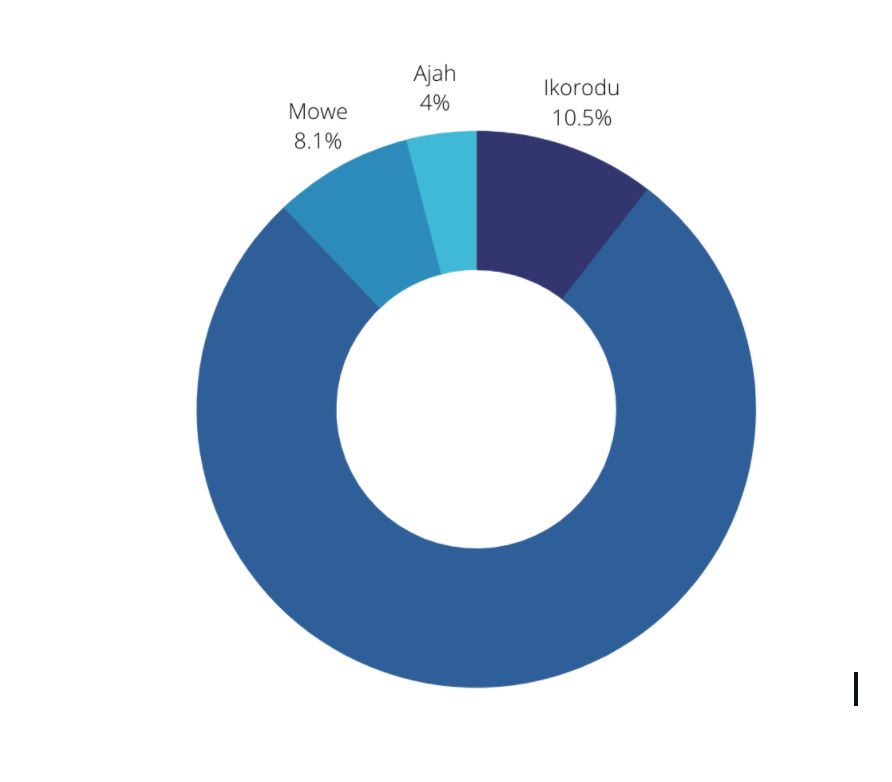
These three estates occupy a combined landmass of 0.475sq mi but yet only 22.6% percentage of the working public can comfortably afford them. I would talk about this research in greater detail in another entry, but for now, while these numbers sink right in it is important to add that there have been encroachments on as well as excisions and outright de-reservations of the forest estate and no one seems to be regulating this.
What about the forest act?
The Forest Act of 1937 gives autonomy to each Governor or Local Government Authority. They get to establish their forest reserves and champion conservation efforts, but instead, de-reservation is common. Since the management and control of forest reserves are theirs to manage, the Federal Department of Forestry has only monitoring functions with zero executive authority in managing forest reserves. This antiquated system makes sure that the overall control in the reserves is ineffective and difficult to enforce.
The current state of affairs draws a stark comparison to the town of Thneedville in the movie Lorax. And not unlike the imaginary town of Thneedville we...
...Thneed our trees and forests
If you look past my love of puns, you would see that trees are vital to expelling carbon dioxide from the atmosphere. They extract around 2.6 billion tonnes of carbon dioxide from the atmosphere each year. A report found that...
“…increased reforestation efforts had the largest carbon storage potential, equivalent to keeping 65 million passenger cars off the road.”
Secondly, as we diminish biodiversity by cutting down forests to build more infrastructure, we increase the risk of disease pandemics such as COVID-19. The analysis of around 6,800 ecological communities on six continents adds to a growing body of evidence that connects trends in human development and biodiversity loss to disease outbreaks — but stops short of projecting where new disease outbreaks might occur.
“We’ve been warning about this for decades,” says Kate Jones, to the Journal Nature. “Nobody paid any attention.”
Pay attention, please.
The recent UN’s Sustainable Development Goals clearly states the need for “rapid, far-reaching and unprecedented changes in all aspects of society.” One of the goals is a halt to land degradation and loss of biodiversity.
We need houses, but we also need trees.
We need trees, but we also need houses.
While this has been about trees and the need to rethink land degradation, I am also aware of the 20M housing unit deficit. In a previous article, I talked about this shortfall; and the necessity for sweeping changes in the housing sector.
Today, I invite you to join our community so that through informed and healthy debate, we can share ideas on how to provide sufficient housing while doing our best to protect our forests. So that in the future no one has to again ask the question:
This is a conundrum because to solve the housing crisis, we may have to encroach into the frontier forests...what we need are well thought-out housing laws and regulations